Overview
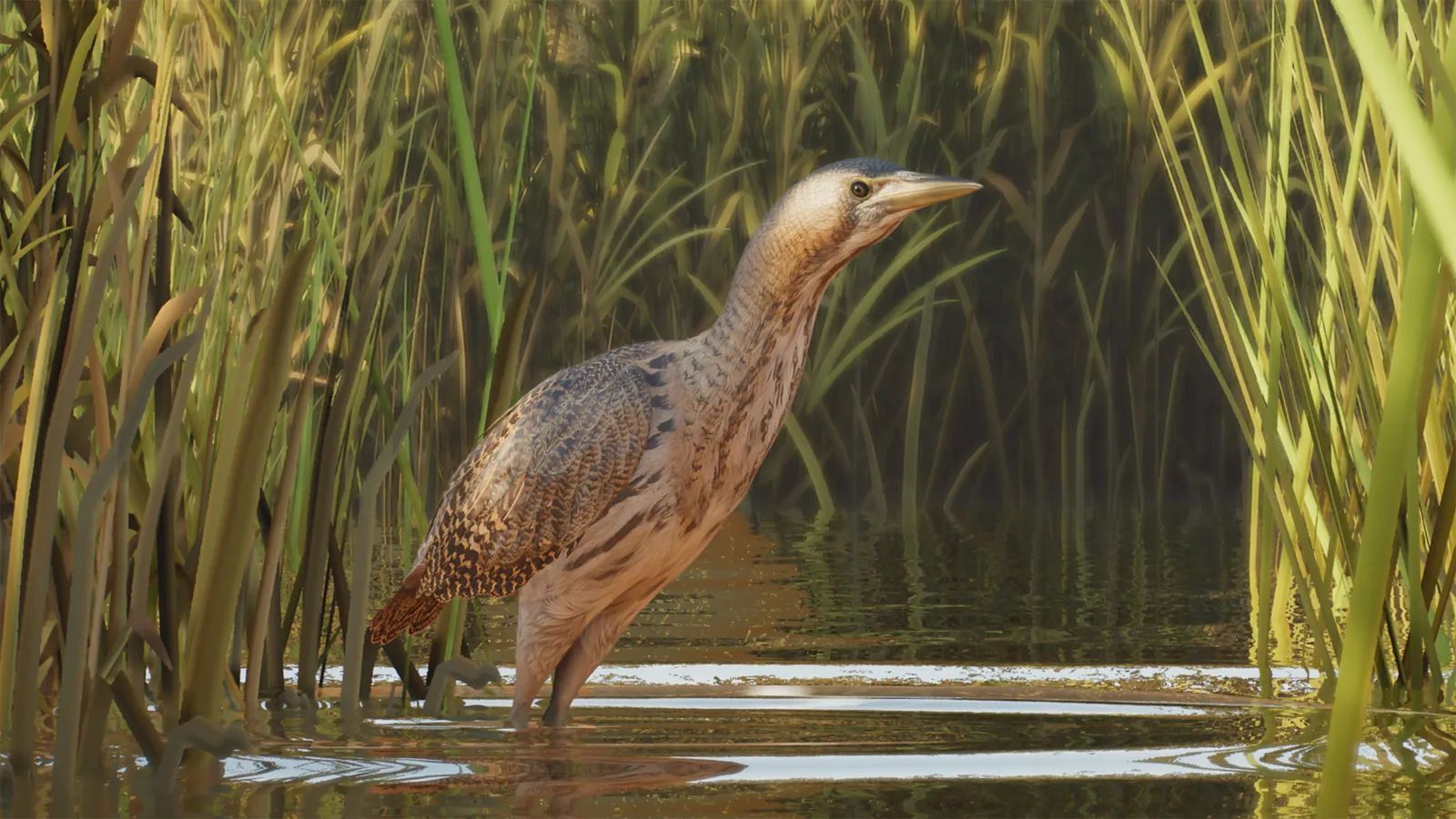
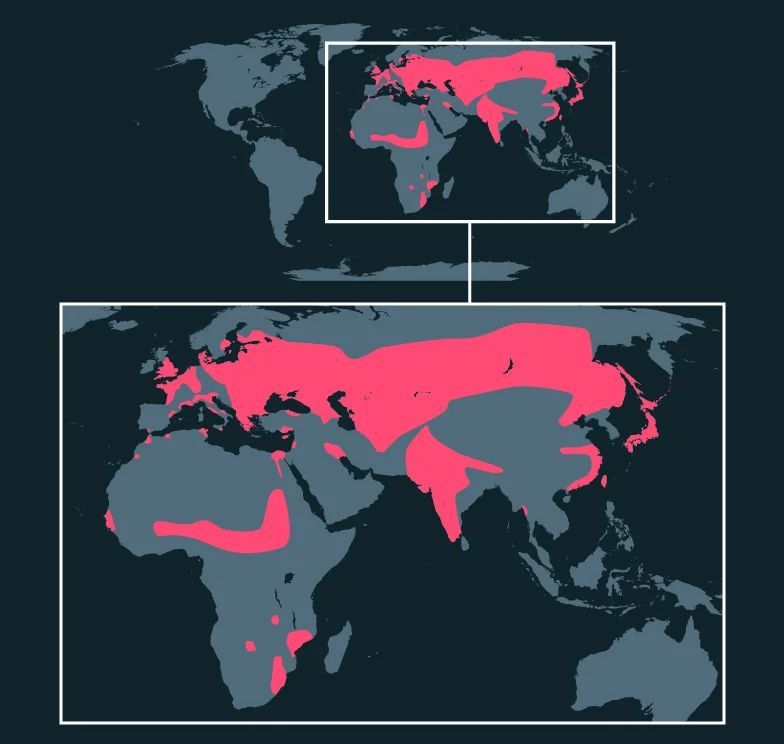
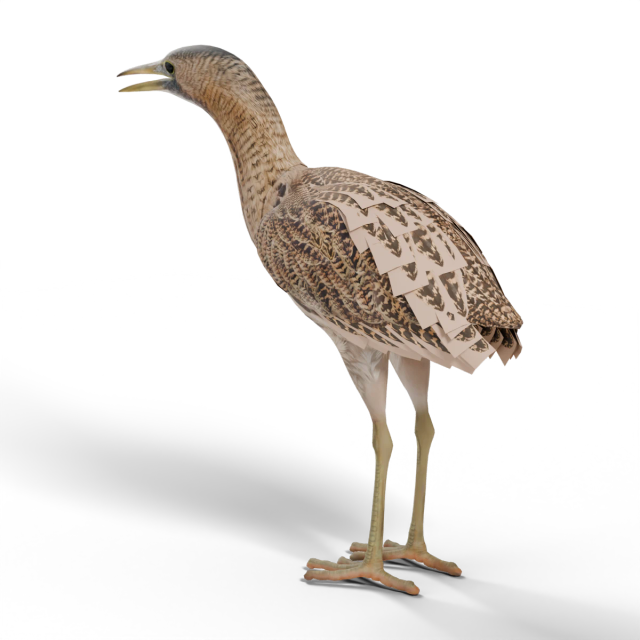
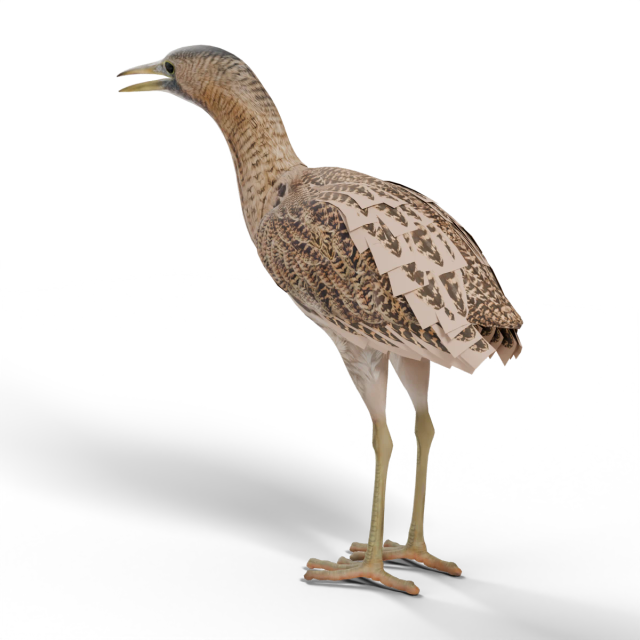
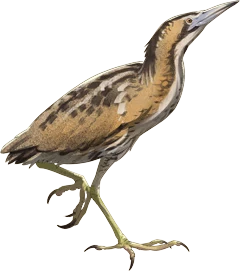
The Eurasian bittern (or Botaurus stellaris), also known as the great bittern, is a large species of heron found across Europe, Asia, and parts of North Africa. It inhabits dense reedbeds and freshwater wetlands with abundant vegetation. Covered in streaked brown plumage, the Eurasian bittern has a stocky body, a thick neck, and a strong, pointed bill, giving it a bulky appearance compared to other herons. Adults typically measure 69cm to 81cm tall, with a wingspan of 100cm to 130cm and weigh between 0.87kg and 1.9kg. Males may be slightly larger than females.


Appearance
Male
Female
Size & weight
Size
Leg span: 1.2 to 1.3 m
Juvenile
Juvenile weight
190 g
Measured as Leg span. The person stands 1.75 m tall for scale.
Habitat requirements
Barrier grade
Grade 2 of 5
Minimum height
1 m minimum
Climbing & water
Climb proof
Not needed
Water barrier
Not allowed
Barriers at this grade
Barrier types with resistance grade 2.



Habitat needs
Minimum area
Land
40 m² + 40 m² per extra animal
Water
25 m² + 15 m² per extra animal
Flying
20 m² + 20 m² per extra animal
Shelter
10 m² per animal
Environment
Temperature
-6 to 25°C
Plant coverage
20-60%
Enclosure
Roofed Habitat
Terrain
- Long Grass 30-100%
- Sand 0-10%
- Waterlogged 20-100%
- Soil 10-30%
- Rock 0-30%
Diet and enrichment
Diet
- Small Whole Fish
- Freshwater Crustaceans



Enrichment items





Water sources

Conservation
IUCN Red List
Least concern
Least concern
Critically endangered
Wild population
184,000
184,000 - 310,000 in the wild. Rank 44 of 58 species with a known count, smallest first.
While today a species of Least Concern, the Eurasian bittern does face fragmentation and degradation of their reedbed and wetland habitat. They rely on dense, tall stands of reeds over shallow water for feeding, breeding and shelter. However, many wetlands have been drained for urban or agricultural expansion, and reedbeds have been fragmented or allowed to become unsuitable through neglect. Additionally, environmental pollution, human disturbance of nesting sites, and the effects of climate change further affect bittern populations. Major conservation efforts focused on environmental restoration are delivering promising results in parts of their range. For example, in the UK, large-scale reedbed creation and restoration is helping to reverse a dramatic decline in wetland ecosystems and thus available bittern habitat. In mainland Europe, bitterns also benefit from programmes focused on habitat restoration, water-level management, and public awareness campaigns about protection of these sensitive ecosystems. These protective efforts have helped near-extinct bittern populations to recover, and, if maintained, will help keep this species stable in the wild.
Zoopedia sketchbook
Social & reproduction
Keeper notes
Eurasian bitterns are solitary birds, although will tolerate other individuals outside of the mating season. Unlike many bird species, they do not form lasting pairs during the breeding season and part ways soon after mating. The breeding season for Eurasian bitterns is from late winter to early spring. During this time, the male establishes a territory within a large reed bed and defends it with his characteristic ‘boom’ call, both to attract females and warn off rival males. He may mate with up to 5 females entering his territory in one season. Following mating, the female builds a nest out of last year’s standing reeds, sedges and stems, creating a shallow floating platform at the water’s edge. Here, she lays a clutch of 3 to 6 eggs. Females are the sole carer for offspring, and after egg-laying, incubation lasts approximately 25 to 28 days. Chicks usually hatch several days apart and then remain in the nest for 2 weeks. After this, they leave the nest and disperse into the surrounding reedbed environment but are still provisioned for by their mother. The chicks fledge fully and gain flight capability at around 6 to 8 weeks of age. Following fledging, the young gradually become independent, though throughout this time the female continues to provide food (often regurgitated prey) until the juveniles can feed themselves entirely. Eurasian bitterns reach sexual maturity at 1 year old.
Group and breeding
Group
Group size
1-2 (up to 1 male, up to 1 female)
Male bachelor group
1
Female bachelor group
1
Offspring dispersal
None
Lifecycle and breeding
Life expectancy
9-11 years
Age of sexual maturity
1 year
Age of sexual sterility
Death
Gestation or incubation
1 month
Interbirth period
12 months
Clutch size
3-6
Mating system
Polygynous
Mating season
Spring
Reproduction in captivity
Average
Research
Research levels
| Level | Unlocks | Research gate |
|---|---|---|
| Level 1 | Thriving Requirement 1: Coarse Sand terrain | |
| Level 2 | Thriving Requirement 2: at least 15 objects or plants with the Reed tag; Eurasian Bittern Fact Sheet | |
| Level 3 | Release groups and release to the wild | |
| Level 4 | Thriving Requirement 3: Food Grade 2; Fertility Level 1 (+15% fertility) | Before this level: an Observation Network (Observation Platform) in Poland Reserve and this species released in Poland Reserve |
| Level 5 | Thriving Requirement 4: at least 50% native plants | |
| Level 6 | Thriving Requirement 5: Sprinkler, at least 2; Fertility Level 2 (+30% fertility) |
Researched by
Vets
Researched at
Habitat or exhibit and Research Centre
Wildlife Reserve
Poland Reserve
Every level of this species' research, with its unlock conditions.
Release groups
Valid release groups
| Group | Type | Animals |
|---|---|---|
| Maternal Family Group | Female group | 1 female |
| Solitary Male | Solitary male | 1 male |
| Breeding Partners | Breeding partners | 1 male, 1 female |
Release requirements
| Requirement type | Requirement |
|---|---|
| Ecosystems Required | Fen Wetland |
| Ecosystems Required | Flourishing Lowland Marsh |
| Nature Requirements | Water Platform Nest - Small |
Ecosystems


Release groups, reserve requirements and the roles this species fills.
Animal facts
- Eurasian bitterns mainly eat fish, amphibians, insects, and small mammals, catching them with quick thrusts of their dagger-like bill.
- The male Eurasian bittern’s deep, foghorn-like boom call can be heard from up to 5km away.
- The male Eurasian bittern’s distinctive call is produced by inflating its oesophagus to act like a resonating chamber. It is one of the most distinctive bird sounds in Europe.
- The Eurasian bittern’s streaked brown and buff plumage blends perfectly with reed stems, making it almost invisible when standing motionless with its bill pointing upward.
- The Eurasian bittern was almost completely extinct in the UK in the late 19th century, but habitat restoration projects have led to a strong recovery.
Taxonomy
Class
Order
Family
Genus
Species