Overview
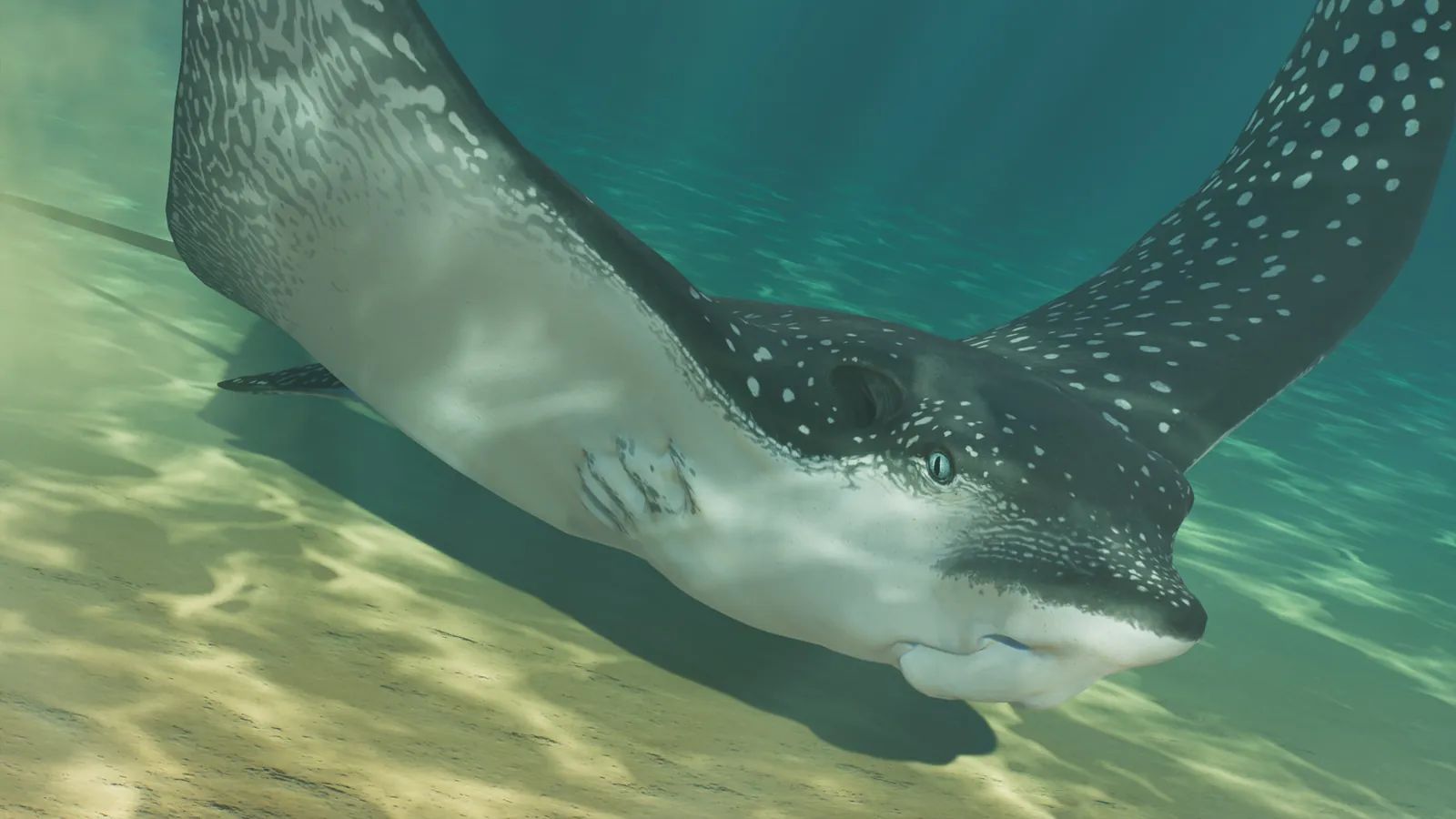
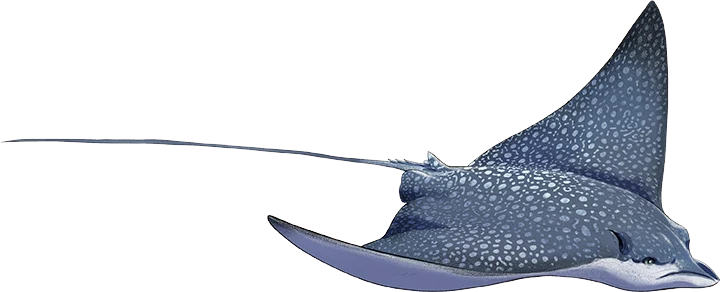
The ocellated eagle ray (or Aetobatus ocellatus) inhabits warm, coastal waters of tropical and subtropical regions throughout the Indo-Pacific, and parts of the eastern Pacific. These rays are typically found in shallow bays, coral reefs, and sandy or muddy seafloors. They have a dark dorsal side covered in bright white spots, a contrasting white underside, a flattened, rhomboid-shaped body, and long, pointed pectoral fins resembling wings. They also have a long, whip-like tail. Adult males measure 1.5m to 2.0m and weigh 20kg to 35kg. Females are larger, measuring up to 2.5m and weigh up to 90kg.
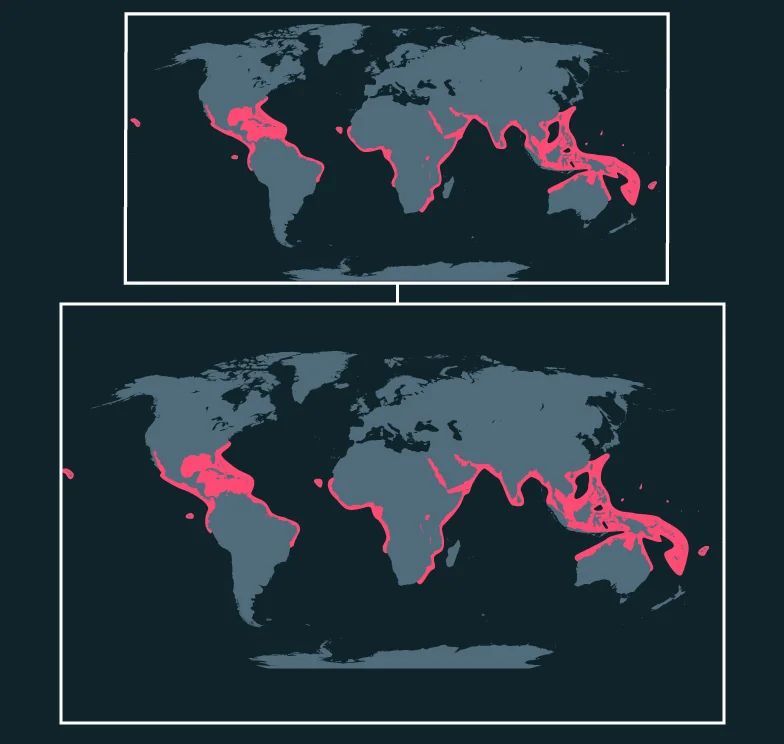
Found in Indo-Pacific reefs and coasts
Regions
No entries.
Biomes
No entries.
Appearance
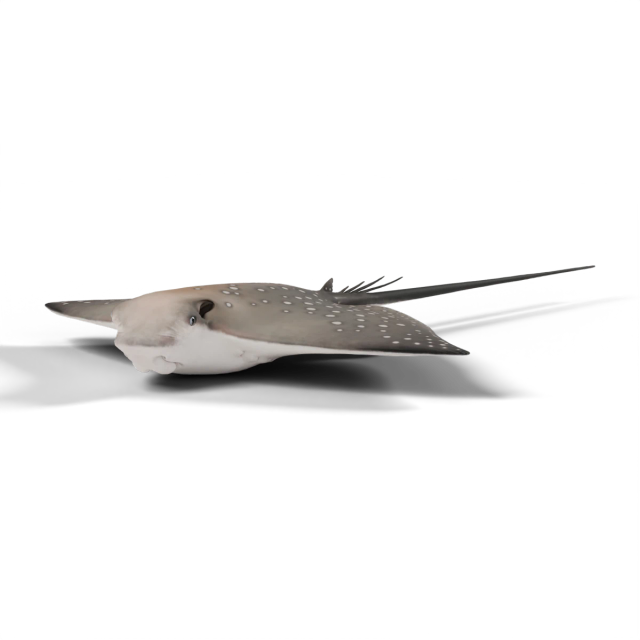
Juvenile
Size & weight
Size
Leg span: 2.5 m
Juvenile
Juvenile weight
5 kg
Measured as Leg span. The person stands 1.75 m tall for scale.
Habitat requirements
Barrier grade
Grade 2 of 5
Minimum height
1 m minimum
Climbing & water
Climb proof
Not needed
Water barrier
Not allowed
Habitat needs
Terrain
- Sand 50-100%
- Soil 0-50%
- Rock 0-20%
Thriving Relationships
Large Indo-Pacific Reef animals: sharing a habitat with one of these species fulfils a Thriving requirement.
No entries.
Diet and enrichment
Diet
- Clams and Crustaceans
- Squid
Feeders
No entries.
Enrichment items
No entries.
Conservation
IUCN Red List
Endangered
Least concern
Critically endangered
The ocellated eagle ray is considered Endangered. As a slow-growing species with low reproductive rates, it is especially vulnerable to overexploitation. It is frequently caught as bycatch in nets and lines intended for other species. In some regions, it is also hunted for its meat, cartilage, and gill rakers. Habitat degradation, particularly the destruction of coral reefs, seagrass beds, and coastal nursery areas, further threatens its populations. Pollution, boat traffic, and climate change–related stressors, make it difficult for populations to recover. Trade in the ocellated eagle ray is regulated to prevent overexploitation. Several countries have fishing regulations, protected areas, and bycatch reduction strategies to safeguard the species. Research programs are using satellite and acoustic tagging to better understand their movements, habitat use, and behaviour. Education campaigns and eco-tourism initiatives help raise awareness and reduce human impacts. While direct reintroduction efforts are limited, preserving healthy habitats and reducing human pressures support the long-term survival of ocellated eagle ray populations.
Zoopedia sketchbook
Social & reproduction
Keeper notes
Ocellated eagle rays may be solitary or loosely social. They are often seen in groups for the purposes of feeding, breeding and travelling. Breeding is seasonal in some regions, often tied to warmer water temperatures and food availability: late spring to early summer is typical. They are thought to reproduce every two years, though reproductive cycles may vary by region and environmental conditions. For courtship, males will follow and nip at females before aligning themselves by interlocking their claspers and transferring sperm via cloacas. Gestation typically lasts around 1 year, and females give birth to 1 to 4 pups per litter. Newborns are miniature versions of adults, measuring approximately 30–45cm and are immediately independent. Ocellated eagle rays reach sexual maturity at around 3 to 6 years of age, with males generally maturing earlier than females.
Group and breeding
Research
Research levels
| Level | Unlocks | Research gate |
|---|---|---|
| No entries. | ||
Every level of this species' research, with its unlock conditions.
Release groups
Valid release groups
| Group | Type | Animals |
|---|---|---|
| No entries. | ||
Release groups, reserve requirements and the roles this species fills.
Animal facts
- Ocellated eagle rays are known for ‘breaching’ - jumping out of the surface of the water, sometimes up to 1m high.
- Ocellated eagle rays have specially adapted teeth that form a flat, rasp-like surface for crushing shells.
- Ocellated eagle rays have venomous spikes in their long, whip-like tail.
- Each ocellated eagle rays have a unique pattern of spots that can be used to identify them like a fingerprint.
- Ocellated eagle rays are named after eagles because of their large wing-like fins.
Taxonomy
Class
Order
Family
Genus
Species